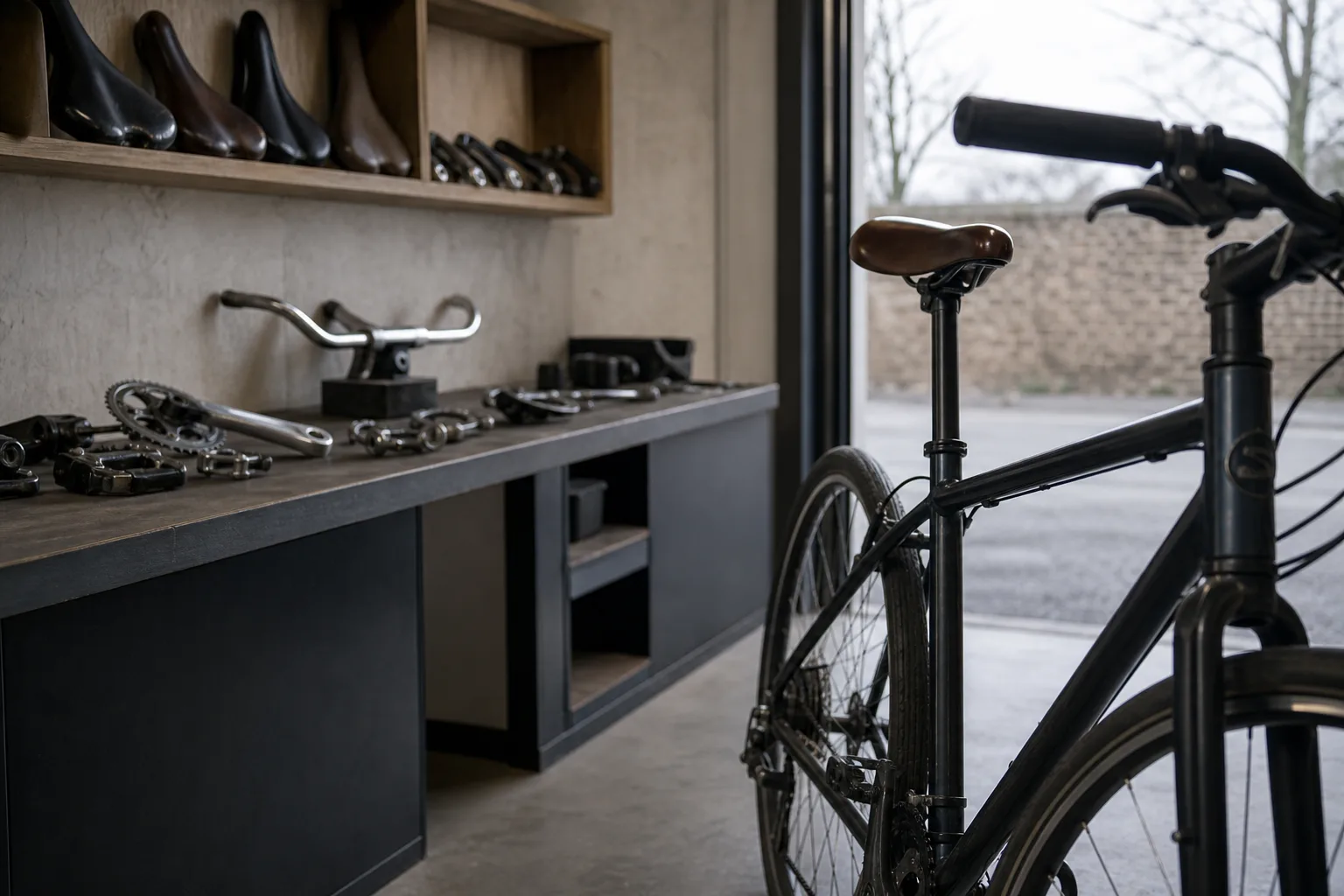
The contact points on a stock hybrid are chosen for an average rider, and changing three of them costs less than changing bikes.
A hybrid leaves the factory with parts chosen for a rider who does not exist: a composite of everyone who might buy that size, weighted toward the middle of the range. The frame is the one component sized to you, more or less, by the chart on the wall. Everything you actually touch was picked by a purchasing department. That is why two people on the identical size 15 hybrid can report opposite verdicts, one comfortable at ten miles, one aching at two, without either of them being wrong about the bike.
The saddle is a measurement, not a preference
Sit bone spacing varies by roughly an inch and a half across adult riders, and a saddle narrower than your bones supports soft tissue instead of skeleton. Most shops have a memory foam pad or a corrugated gel board that takes an impression in about thirty seconds, and the number it gives you is the starting width, plus a small allowance for how far forward you rotate on the bike. Upright hybrid posture usually means a wider saddle than a road fit would call for. Ask for the measurement before you accept a stock saddle as a fixed feature of the purchase.
Cost sits in the low double digits for a serviceable replacement and climbs into three figures for cutout designs with hollow rails, but the expensive ones are not automatically the right ones. What matters is width, then the shape of the nose, then padding density, in that order. A careful reader checks whether the shop runs a saddle exchange program, because the second saddle is often the one that works, and paying twice for a guess is the ordinary outcome without a return window.
Bar width, and why smaller riders sit too wide
Flat bars on hybrids commonly arrive at 660 to 700 millimeters, a width inherited from mountain bike fashion, where leverage on rough ground justifies it. On pavement, with narrow shoulders, that width rotates your palms outward, opens the chest past where it wants to be, and puts a steady load on the outside of each wrist. Cutting a bar down is a five minute job with a pipe cutter and costs almost nothing if the shop does it while the bike is on the stand. Measure the bony points of your shoulders and start there.
The catch is grip and control hardware: shifters and brake levers have to come off and go back on, and a bar with graphics or a fixed clamp diameter limits how much you can remove. Anything beyond about forty millimeters per side usually means a new bar, which is a modest part and an hour of labor. Narrower bars also quicken the steering slightly, which most everyday riders read as more responsive rather than nervous.
Crank length, the part nobody offers to change
A 170 millimeter crank is the default on almost every hybrid regardless of frame size, and on a rider with a 27 inch inseam that means a knee traveling through a bigger arc than the hip wants to allow. Shorter cranks, 165 or 160, reduce the height the knee has to reach at the top of the stroke, which is where most saddle height compromises come from. Riders often find they can finally set the saddle high enough for a straight leg extension once the top of the pedal circle drops. Expect a mid range cost for the crankset itself and a bottom bracket check with it.
Levers, grips and the reach adjustment already on your bike
Brake levers on most hybrids have a small reach screw, often a hex bolt facing the bar, that pulls the lever blade closer to the grip. It costs nothing and takes two minutes, and it is skipped on nearly every bike sold. Smaller hands should be able to wrap the first two finger joints around the lever without stretching. The Consumer Product Safety Commission is responsible for the federal requirements that govern how bicycles are assembled and sold in the United States, and braking hardware falls under that remit, so the adjustment range is there to be used.
Grips are the cheapest change on the bike and the one with the fastest return: a locking grip in a diameter matched to your hand, ergonomic wing or plain round, stops the palm rolling. Ask for grips, a saddle swap, a bar cut and lever adjustment to be bundled into the sale price while the bike is still unsold inventory, because a shop with margin on a complete bike will usually absorb parts and labor it would otherwise bill separately.
Take the tape measure to the shop. Sit bone width, shoulder width, inseam, and hand span answer more questions about how a hybrid will feel than the size letter on the down tube ever will.